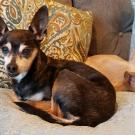
“We were devastated to learn our beloved Chihuahua Pixie, had leukemia," said Pixie's owner. "Things did not look good, but with the help of the doctors at the UC Davis veterinary hospital, we decided on chemotherapy treatment."
Have you ever wondered where police horses end up when they retire? Most are adopted out to private sanctuaries or rescue organizations, often times being visited by their former partners. The T.S. & K.D. Glide Foundation on the outskirts of Davis houses eight of them.
Roxie, a 12-year-old female Shih Tzu, was having trouble moving her hind legs, to the point of becoming partially paralyzed. After being referred to the Neurology/Neurosurgery Service at the UC Davis veterinary hospital, an evaluation of Roxie showed her to have an arched posture, avoided moving her neck, and had some incoordination in her hind legs.
Miao Miao, a 4-year-old male domestic shorthair cat, was brought to the UC Davis veterinary hospital with persistent nosebleeds. Based on previous medical issues, his owners were aware that he had some variation of a blood platelet disorder (causing an inability to properly clot blood), but the exact make-up of that was never discovered.
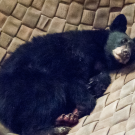
A young black bear whose paws were burned raw in the Carr Fire is recuperating with special care from a wildlife veterinary team.
On Monday, an eight-member team including Dr. Deana Clifford and Dr. Jamie Peyton of the UC Davis Veterinary Medical Teaching Hospital spent nearly six hours preparing for the operation and sewing tilapia skin onto the bear's four paws. One benefit of the fish skin — which doesn't smell fishy — is that it contains collagen that aids in healing.
UC Davis veterinary specialists are helping a baby snow leopard, born in May at the Sacramento Zoo, with a condition known as “swimmer’s syndrome,” a developmental deformity that forces animals to paddle their legs like turtles when they try to walk.
The zoo’s snow leopard cub is one lucky cat. Despite being born with several birth defects affecting his eyes and abnormal development of his rear legs and chest, the cub is receiving the very best care and world-class veterinary treatment to help him overcome these challenges.
Crash, a 6-year-old male German shepherd, was starting to tire more easily on his walks and seemed “spacey” and listless. An MRI revealed an intracranial arteriovenous malformation (AVM)-more commonly seen in humans-located within the brain and behind his eyes. Veterinary neurosurgeons collaborated with human specialists to treat his condition.
Dazzy, a 4-year-old male French bulldog, began having seizures and acting aggressive toward strangers – a behavior he had never previously displayed. His owners took him to see their primary veterinarian who ultimately referred them to a neurologist near their home in Southern California. An MRI performed by the neurologist revealed a left intra-axial cerebral mass, most consistent with a glioma (brain tumor).