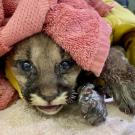
An orphaned mountain lion cub is at the Oakland Zoo recovering from burn injuries after being rescued from California's Zogg Fire. The zoo staff is working with the UC Davis Veterinary Hospital to treat the cub's wounds.
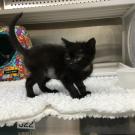
So, what do a local university patron, four veterinary hospital services, a veterinary resident, a newly graduated Animal Science major, and dozens of faculty, staff, and student caregivers have in common? All of these UC Davis entities came together to save the life of a tiny kitten barely big enough to fit in your hand.
Kita, a 10-year-old female American Staffordshire terrier, began limping on her front right leg in November 2019. Shortly thereafter, she refused to walk at all. Her primary veterinarian diagnosed her with osteosarcoma in the leg. Her owners chose to have the leg amputated. Following amputation, Kita was referred to the UC Davis veterinary hospital for further recommendations on treating metastasis of the tumor.
Prince, a 9-year-old male standard poodle, was referred to the UC Davis veterinary hospital in 2017 for further evaluation of a lump on his right hind leg. His owner reported it has been there for about a year and had not changed in size.
One year ago, Sunny, a 9-year-old male Labrador retriever/pit bull mix, was lethargic and hadn’t eaten in several days. His owner, David Newsom, took him to his primary veterinarian, and x-rays revealed a large mass in his abdomen. Sunny was referred to the UC Davis veterinary hospital for further evaluation.
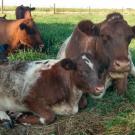
The Schuler Ranch in Yuba City is a small beef cattle operation with about 25 head of shorthorns. The 2020 calving season started out as normal as any calving season of the past, with four healthy calves being born, including a set of twins. When the next group of cows calved, five of their newborns became ill at the same time. It was clear that something devastating could be going through their small herd and could wipe it out quickly. After onsite veterinary services could not save one of the sick calves, they rushed the four others to the Large Animal Clinic (LAC) at the UC Davis veterinary hospital.
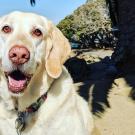
In 2015, Izzie, a 6-year-old female yellow Labrador retriever, was a typical active Lab. She loved playing ball, chasing birds, and swimming. When her owners, Morgan and George Birdsong, noticed a tumor growing on her head, they immediately took her to their veterinarian. After diagnosing it as a mast cell tumor, Izzie’s primary veterinarian and a second opinion both offered palliative care as the best option, not giving her very long to live. At this point, Izzie’s tumor had grown to the size of a tennis ball.
When Violet, 2-year-old female French bulldog, was rescued by Alyssa Sterns, she had already been through more health problems than any young dog should. Overbred by a breeder, Violet developed hip dysplasia and had undergone surgery on both hips. Now, she developed a mast cell tumor on the paw of her left hind limb. Violet’s veterinarian informed Sterns that the tumor would be difficult to remove without amputating the paw, which was not ideal given her hip problems. So, Sterns took Violet to the UC Davis veterinary hospital for a second opinion.
Jack the Shih Tzu was 7 years old when he traveled from Ontario, Canada to the UC Davis veterinary hospital in 2015. Given a cancer diagnosis with only a few months to live and with limited immediate treatment options, Jack’s family started a frantic search for help elsewhere. The search was a quick one, though, as one of the first items that appeared in their online hunt was a first-of-its-kind clinical trial at UC Davis to treat his exact condition.
Mugsy, 12-year-old male pit bull terrier, was diagnosed with mast cell tumors in mid-2019. Owner Sarah Robinson—who adopted Mugsy 11 years prior while in nursing school—knew the prognosis wasn’t good, but wanted to seek the expertise of the cancer specialists at the UC Davis veterinary hospital, since oncology services were not available in her hometown of Reno.