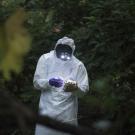
Climate change is likely to drive rodent-borne arenaviruses into parts of South America that have never faced these diseases, putting new communities of people at risk, finds a study from the University of California, Davis.
Breathing in common disinfectant chemicals known as quaternary ammonium compounds, or QACs, may be far more harmful than swallowing them, according to a mouse study led by researchers at the University of California, Davis. The study found significant lung injury at blood QAC exposure levels similar to those measured in humans.
When the H5N1 highly pathogenic avian influenza virus was discovered on a poultry farm in Asia in 1996, there was little indication that it would become so widespread and so destructive. Within 30 years, it reached every continental region except Oceania, infecting more than 400 million poultry, tens of thousands of elephant seals and sea lions, about 1,000 people and many other mammals and wild birds.
Pinnipeds, which include seals and sea lions, have been hit unusually hard by the virus.
Seven weaned elephant seal pups in California’s Año Nuevo State Park tested positive for highly pathogenic avian influenza (HPAI) H5N1, the U.S. Department of Agriculture’s National Veterinary Services Laboratory confirmed Tuesday evening.
The University of California, Davis, today announced the largest gift ever made to veterinary medicine worldwide: $120 million from philanthropists Joan and Sanford I. Weill through the Weill Family Foundation to support its top-ranked veterinary school.
In recognition of this commitment, the university has renamed the school the University of California, Davis, Joan and Sanford I. Weill School of Veterinary Medicine — or simply the UC Davis Weill School of Veterinary Medicine.
Jonna Mazet arrived at UC Davis as an undergraduate curious about veterinary medicine in 1986, and is retiring four decades of groundbreaking campus initiatives later, having built a legacy of cross-discipline innovation on global health problem-solving, particularly regarding emerging infectious diseases and conservation challenges.
"I am always motivated by the excellence, innovation and the collaborative spirit at UC Davis," she said.
Protecting wildlife health is critical to achieving a more sustainable future, according to new research linking wildlife health surveillance to the United Nations’ Sustainable Development Goals (SDGs).
Ecological medicine is a new approach to health science that draws on a very old idea: connecting with each other, with animals and plants, and with the natural world fosters health and well-being for people and the planet.
“Everything you suspected was good for you -- fresh air, trees, animal companions, purpose, reciprocity -- turns out to have peer-reviewed backing,” said Rebecca Calisi Rodríguez, associate professor of neurobiology, physiology and behavior and director of the Green Care Lab at the University of California, Davis.
As one of the world’s first fetal surgeons, Diana Farmer has long been focused on the smallest of patients.
She specializes in treating birth defects inside and outside of the womb, treating congenital anomalies and cancer and performing airway and intestinal surgeries. In the late 1990s, she became the first woman in the world to perform open fetal surgery.