Large Animal

Equine Reproduction Service Updates Facilities at the Center for Equine Health

The UC Davis veterinary hospital’s Equine Reproduction Service has a newly renovated clinical teaching and research space at the school’s Center for Equine Health. Dean Michael Lairmore, Executive Associate Dean John Pascoe, and Executive Assistant Dean Mary McNally officially unveiled the newly renovated space, which includes four custom-designed stocks and all new flooring. The Equine Reproduction Service team, led by Service Chief Dr. Ghislaine Dujovne and newly acquired faculty member Dr. Pouya Dini, also has a new student meeting space and expanded laboratory as part of the renovation.

New Procedure More Efficient for Ovariohysterectomy on Horse

Georgia, an 18-year-old warmblood mare, was brought to the UC Davis veterinary hospital after a recent change of ownership. The previous owners disclosed she had been treated medically for chronic endometritis (inflammation of the uterine lining) over the past several years without resolution of the condition.

UC Davis Cares for 1,000 Animals from Wildfires

Since August 19, the UC Davis School of Veterinary Medicine has been treating animals burned in the devastating LNU Lightning Complex Fire. Using a field-first approach, the school's Veterinary Emergency Response Team (VERT) deployed to Solano and Sonoma Counties to care for animals at evacuation centers and those sheltering in place on ranches. They also conducted search and rescue missions throughout the fire zones. Meanwhile, the veterinary hospital has been able to concentrate on only the most critical cases.

Wildfires: The University Responds

Faculty, staff, and students from the School of Veterinary Medicine have responded to the LNU Lightning Complex Fire with a swift deployment of the Veterinary Emergency Response Team in the field and the Disaster Response Committee at the veterinary hospital.

Swift Care Saves Newborn Calves from Deadly Infections

The Schuler Ranch in Yuba City is a small beef cattle operation with about 25 head of shorthorns. The 2020 calving season started out as normal as any calving season of the past, with four healthy calves being born, including a set of twins. When the next group of cows calved, five of their newborns became ill at the same time. It was clear that something devastating could be going through their small herd and could wipe it out quickly. After onsite veterinary services could not save one of the sick calves, they rushed the four others to the Large Animal Clinic (LAC) at the UC Davis veterinary hospital.

Equine PET Scanner Making Big Strides at Santa Anita Park

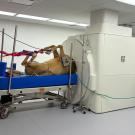
The equine Positron Emission Tomography (PET) scanner pioneered by the UC Davis School of Veterinary Medicine, in collaboration with LONGMILE Veterinary Imaging, is now in heavy use at Santa Anita Park in Southern California. In just over six months since the installation in December 2019, with the financial support from the Stronach Group, more than 100 scans have been performed with the “MILEPET” (Molecular Imaging of Limbs in Equids), the PET scanner specifically designed to acquire images on horses without the need to lay them down.

Equine Residents Win Orthopedic Research Awards

Drs. Jannah Pye and Tom Cullen, equine surgery residents at the UC Davis veterinary hospital, were recently awarded the Mark S. Bloomberg Memorial Resident Research Award by the Veterinary Orthopedic Society (VOS). The two were among a handful of residents throughout the country award the prize. They were recognized in February at the VOS Annual Conference in Sun Valley, Idaho, before the COVID-19 pandemic caused all veterinary conferences to cease in-person activities.

Three Equine Specialties (and a Dedicated Family) Come Together to Heal Horse

Cooper, a 16-year-old quarter horse gelding, was brought to the UC Davis veterinary hospital after his owner, Robyn Armstrong, noticed spooking behavior over the past few months. Her normally friendly horse was not letting her near him. The hospital’s ophthalmologists noticed an obstruction in Cooper’s vision, but also noticed an unrelated abnormality on his face. The two separate conditions initially concerned Armstrong and set Cooper back a few months, but ultimately, he emerged a much healthier, happier horse.