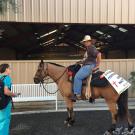
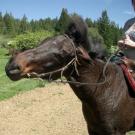
Six years ago, Star-Buck was near death. Emaciated and weighing only 400 pounds, he was rescued by Angela Wood and friends. Now, the 10-year-old American Quarter Horse gelding is strong enough to walk across the country with Wood to raise awareness for childhood hunger.
Researchers at the UC Davis School of Veterinary Medicine have published the results of a study that investigated the frequency of the Warmblood Fragile Foal Syndrome (WFFS) mutation in Thoroughbreds. The study demonstrated that the WFFS mutation is not a genetic risk factor for catastrophic breakdown and is only present at a very low frequency in this breed.
Monty, a 6-year-old Thoroughbred gelding, was down and displaying signs of colic when owner Ashley Aguado received the late-night call that he was sick. She rushed to him and found her three-day eventing horse in a dire condition.
“When I arrived, Monty’s face was cut up from all the rolling he was doing,” said Aguado. “He was sweating and just didn’t look good overall.”
This statement is in response to discussions that have arisen due to inaccurate IMM/MYH1 genetic test results by a non-UC Davis affiliated laboratory. UC Davis is issuing this statement because of its relationship to research related to this test, because it has its own patent-pending IMM genetic test, and because the UC Davis Veterinary Genetics Laboratory offers the test as a service.
The Center for Equine Health is home to a dementia research program by the UC Davis School of Medicine and Connected Horse. Read more about the project and watch a video from PBS on the equine therapy program.
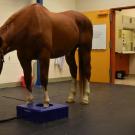
A significant advance in veterinary research is coming to the racetrack in the form of a standing equine PET scanner. The machine will soon be available at Santa Anita Park, marking a major milestone in the battle against racetrack injuries.
Giving magnesium and boron can benefit headshaking horses, the findings of research suggest. Trigeminal‐mediated headshaking, which used to be called idiopathic headshaking, is caused by a low threshold of firing of the trigeminal nerve in the face. In most cases, the condition is worse during spring and summer, and geldings are over-represented. Various treatments have been tried, including face masks with ultraviolet light protection, nose nets, nutritional supplements, antihistamines, corticosteroids, neuromodulation, and even surgery on the nerve. Results have been variable.
The ongoing Equine Respiratory Biosurveillance Program between UC Davis School of Veterinary Medicine and Merck Animal Health revealed new information on infectious respiratory disease threats, including EHV-1 and EHV-4, influenza, S. equi, equine rhinitis A/B viruses, and more. Here’s what you should know.