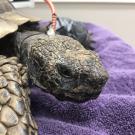
Mohave, a 61-year-old desert tortoise, was recently brought to the UC Davis veterinary hospital for a recurrence of bladder stones. Thanks to a minimally invasive procedure that saved his shell, and a UC Davis alumna connecting with her alma mater, Mohave is on the mend.
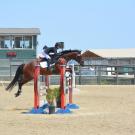
Monty, a 6-year-old Thoroughbred gelding, was down and displaying signs of colic when owner Ashley Aguado received the late-night call that he was sick. She rushed to him and found her three-day eventing horse in a dire condition.
“When I arrived, Monty’s face was cut up from all the rolling he was doing,” said Aguado. “He was sweating and just didn’t look good overall.”
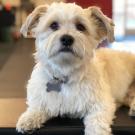
Charlie, a 2-year-old male Maltese mix, and his owner, Tyler Wilcox, were on a routine walk in their neighborhood when Charlie was severely attacked by a much larger dog. The other dog had Charlie is his mouth—shaking him violently—and was not letting go. Wilcox was forced to intervene, having to get physical with the other dog in order to save Charlie. Charlie was rushed to the nearest veterinary clinic where he was sedated and stabilized, but it was clear that his injuries were life threatening – he would need surgery within a few hours.
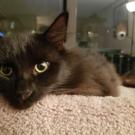
Dinx, a 10-year-old female cat, was brought to the UC Davis veterinary hospital for evaluation of a low grade soft tissue sarcoma mass on her ear that grew back after surgical removal a year prior. Most likely, another surgery would be required to remove the mass.
Rhyme, a 2-year-old male ragdoll mix cat, was being medically managed for a liver shunt for the past six months. That followed nearly two years of trying to discover the root of his illness, which seemed to have plagued him for as long as could be remembered. When a specialist in Rhyme’s hometown of Vancouver, British Columbia finally diagnosed the shunt, he recommended Dr. Bill Culp at the UC Davis veterinary hospital, who has been performing a minimally invasive procedure to correct shunts in dogs for many years. Luckily for Rhyme, Dr. Culp has also utilized this technique in cats when presented with a similar scenario.
Oso, a 2-year-old chocolate Labrador retriever, started dragging his back legs while on a walk. His veterinarian in Bend, Oregon—surgeon Dr. Mauricio Dujowich, a UC Davis alum—performed an MRI that revealed a massive tumor inside his spinal cord, pinching the nerves to his back legs.
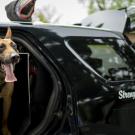
Aero, a 7-year-old German shepherd-Belgian Malinois mix, is back in action with the Anderson (CA) Police Department as a narcotics-detecting K9 officer. Four years ago, however, he was forced to prematurely retire after a mysterious illness caused his energy levels to plummet and his muscles to atrophy. His handler, Officer Mike Hallagran, did not think Aero would survive.
Bobby, a 12-year-old male miniature Schnauzer, developed cataracts in both eyes, presumably brought on by his diabetes. While he could still sense light in his eyes, the cataracts clouded his vision to the point of essential blindness. Navigation of his home was accomplished by memory and by utilizing a heightened sense of feel, especially on the staircase.
Ginger, an 8-year-old female eclectus parrot, was not feeling like herself a few months ago. Over the course of several days, her decreased appetite caused her to skip a meal of kiwi—her favorite fruit—and she no longer danced around her cage like normal. Her owners thought she was having trouble with egg binding, a condition she suffered from previously. As regular clients of the Companion Exotic Animal Medicine and Surgery Service at the UC Davis veterinary hospital, they brought Ginger in for an examination.
Rally, a 1-year-old female Labrador retriever, was accidentally shot while on a hunting excursion, with both of her eyes sustaining major trauma. She was referred her to the Ophthalmology Service at the UC Davis veterinary hospital who helped save her vision.