Dr. Hugues Beaufrere, an associate professor in the Companion Exotic Animal Medicine & Surgery Service, recently won the 2023 Association of Avian Veterinarians (AAV)/Lafeber Manuscript Award in the Best Original Research category.
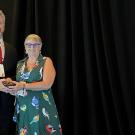
Dr. Michelle Hawkins was recently awarded the 2023 T.J. Lafeber Avian Practitioner of the Year Award, presented to an outstanding practitioner who is advancing the quality of health care for companion birds.
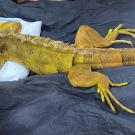
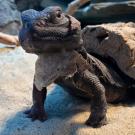
Ragoth, a 4-year-old male green iguana, was treated with chemotherapy and radiation therapy at the UC Davis veterinary hospital for his mast cell tumors.
The Companion Exotic Animal Medicine and Surgery Service at the UC Davis veterinary hospital provides wellness care, specialized diagnostic testing, medical treatments, surgical options, and emergency care for exotic companion animals.
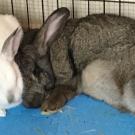
Jill Harris of San Francisco has been a dedicated and experienced rabbit owner for more than 20 years, enjoying volunteering at rabbit rescues and creating fun names for her many rabbits over the years. When her rabbit Lady Alaia McBiggs, an 8-year-old female Flemish giant, experienced a bulging right eye, Harris immediately took her to their primary veterinarian. X-rays there proved inconclusive, so Lady Alaia McBiggs was referred to the Companion Exotic Animal Medicine and Surgery Service at the UC Davis veterinary hospital for more advanced imaging to discovery the cause of the bulge.
Thanks to corporate and private donations, the nation’s largest veterinary house officer (residents, interns, fellows) program at the UC Davis School of Veterinary Medicine just got even larger. The advanced training programs for veterinarians range from one year (fellowships and internships) to two-four years (residencies). Following completion of residency programs, veterinarians are able to sit for rigorous testing procedures to seek board certification in a specialty area of veterinary medicine (internal medicine, surgery, dermatology, cardiology, etc.).
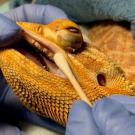
Rex, a 5-year-old male bearded dragon, was brought to the UC Davis veterinary hospital following a period of inappetence, lethargy, and dehydration. His mouth appeared very unhealthy, and his owners were concerned that it was the primary cause of his lack of desire to eat and drink. They hoped that the veterinarians in the Companion Exotic Animal Medicine and Surgery Service could help.
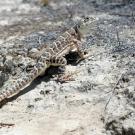
Detection dogs trained to sniff out the scat of an endangered lizard in California’s San Joaquin Valley, combined with genetic species identification, could represent a new, noninvasive sampling technique for lizard conservation worldwide.