In 2016, then 4-year-old Mustang mare Magic was one of 279 wild horses rounded up by the Bureau of Land Management (BLM) following the massive Soda Fire in Idaho, which destroyed more than 279,000 acres of their critical habitat. To prevent their starvation, BLM rescued the wild horses. Between 2016 and 2019, many of the horses, including Magic, were adopted out, and others were returned to the wild when their grazing area grew back.
“I call them my Geriatric Club,” joked horse owner Laura Croyle, referring to her three horses – Big Chief and Little Cloud, both 20-year-old miniatures, and Dex, a 30-year-old mustang.
The three “brothers” have been herd mates for 10 years and are inseparable. So, it’s understandable when Dex and Little Cloud put up a fuss when Big Chief was taken to UC Davis for five days. The miniature gelding developed a case of colic and was writhing in pain when Laura and her husband Warren found him one morning four months ago.
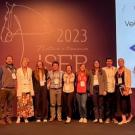
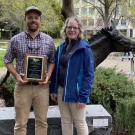
Dr. Nicola Pusterla, professor of equine medicine and dentistry, was awarded the 2025 Advancement in Equine Research Award presented by Boehringer Ingelheim, a biopharmaceutical company active in both human and animal health. The award was given during the 71st annual American Association of Equine Practitioners Convention held last week in Denver. Recipients of the award are chosen based on their research proposals which focused on this year’s subject matter of equine infectious disease.
Two years ago, Brandon and Lisa Bacon were looking to purchase a horse for their 12-year-old son Jackson. Through their contacts as the owners of a horse supply company in Northern California, they discovered Ricky, a then 13-year-old American Quarter Horse gelding.
“Jackson has big ‘Gold Buckle’ dreams,” Lisa said. “We’re so proud of how hard he works at this, and we were thrilled to find Ricky, who was already an experienced roping horse.”
An extremely specialized equine surgery performed by only about a dozen veterinarians nationwide is now available at UC Davis. Thanks to the addition of Dr. Carter Judy to the faculty, as well as a dedicated large bore equine CT scanner, the UC Davis William R. Pritchard Veterinary Medical Teaching Hospital (VMTH) now offers foraminotomy surgery for horses with cervical foraminal stenosis—a narrowing of an intervertebral opening where the limb nerve root exits the spinal column.
Four years ago, Joe Juice, a then 15-year-old American Quarter Horse gelding, had a sialolith removed from the right side of his face at the William R. Pritchard Veterinary Medical Teaching Hospital (VMTH). He recovered quickly and returned to his role as a member of the UC Davis Center for Equine Health’s (CEH) teaching herd.
With foaling season right around the corner, specialists in the UC Davis Equine Reproduction Service are urging their clients to schedule ultrasounds late in their mares’ pregnancies.
Once a mare is confirmed pregnant early in gestation, she is often rechecked shortly afterward to confirm embryo or fetal viability.
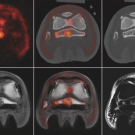
The UC Veterinary Medical Teaching Hospital opened the All Species Imaging Center, a central hub for all advanced diagnostic imaging including small animal computed tomography (CT), high field magnetic resonance imaging (MRI) for both small and large animals, positron emission tomography (PET)/CT for both small and large animals, and a dedicated large bore equine CT.