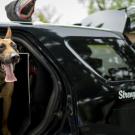
Aero, a 7-year-old German shepherd-Belgian Malinois mix, is back in action with the Anderson (CA) Police Department as a narcotics-detecting K9 officer. Four years ago, however, he was forced to prematurely retire after a mysterious illness caused his energy levels to plummet and his muscles to atrophy. His handler, Officer Mike Hallagran, did not think Aero would survive.
Bobby, a 12-year-old male miniature Schnauzer, developed cataracts in both eyes, presumably brought on by his diabetes. While he could still sense light in his eyes, the cataracts clouded his vision to the point of essential blindness. Navigation of his home was accomplished by memory and by utilizing a heightened sense of feel, especially on the staircase.
Ginger, an 8-year-old female eclectus parrot, was not feeling like herself a few months ago. Over the course of several days, her decreased appetite caused her to skip a meal of kiwi—her favorite fruit—and she no longer danced around her cage like normal. Her owners thought she was having trouble with egg binding, a condition she suffered from previously. As regular clients of the Companion Exotic Animal Medicine and Surgery Service at the UC Davis veterinary hospital, they brought Ginger in for an examination.
Rally, a 1-year-old female Labrador retriever, was accidentally shot while on a hunting excursion, with both of her eyes sustaining major trauma. She was referred her to the Ophthalmology Service at the UC Davis veterinary hospital who helped save her vision.
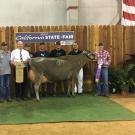
Tag 1839, a 2-year-old Jersey dairy cow, was brought to the UC Davis veterinary hospital for suspected pneumonia. She had been treated appropriately by her primary veterinarian, but without significant improvement, so she was referred to the Livestock Medicine and Surgery Service for further diagnostics and treatment. A blood test showed evidence of severe chronic inflammation, and an ultrasound showed that she had fluid, inflammation, and an abscess in her chest cavity. Radiographs of her chest showed that she had a foreign body—a piece of wire—extending from the first compartment of her stomach toward her heart.
Veterinarians collaborated with human doctors on a case involving removal of a massive sinus osteoma near a horse's eye and brain. An image-guided navigation system allowed surgeons to operate while identifying the precise position of their surgical instruments on a CT scan at every moment.
Pet parent Laci Ping had just 15 minutes to pack up her life—which included six cats, six chickens, three dogs, and three reptiles—as the Camp Fire approached her home in Paradise, California. She managed to secure all but one of her animals – 5-month-old Mayson, a male gray tabby cat. Scared of what was happening, Mayson escaped at the last minute. Ping tried frantically to catch him, but he ran away too quickly. Heartbroken, Ping was forced to leave without him.
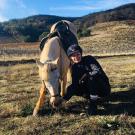
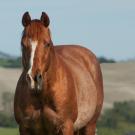
Holly, a 23-year-old American Quarter Horse gelding, was found in his paddock lame on the right front forelimb with a wound over his elbow. The UC Davis veterinary hospital’s Equine Field Service was quickly dispatched to the ranch, and radiographs taken there revealed a fracture of the right olecranon – the curved top of the ulna in the elbow joint.
A UC Davis veterinary patient is being described as a miracle by her owner. When Ethel, a 2-year-old Yorkshire terrier, was rescued by MaryAnn Lawson, the rambunctious pup was in a cast for a broken leg. Unfortunately, two previous surgeries failed to properly heal her broken right ulna and radius (equivalent to both bones in a human’s forearm). Lawson forged on and consulted with other veterinary orthopedic surgeons, all of whom recommended amputating the leg.