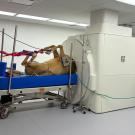
Cooper, a 16-year-old quarter horse gelding, was brought to the UC Davis veterinary hospital after his owner, Robyn Armstrong, noticed spooking behavior over the past few months. Her normally friendly horse was not letting her near him. The hospital’s ophthalmologists noticed an obstruction in Cooper’s vision, but also noticed an unrelated abnormality on his face. The two separate conditions initially concerned Armstrong and set Cooper back a few months, but ultimately, he emerged a much healthier, happier horse.
Grayson-Jockey Club Research Foundation announced that the UC Davis K.L. Maddy Equine Pharmacology Laboratory has been chosen as the research site for a project to help develop alternate methods for detection of bisphosphonates in Thoroughbreds. The research will be funded by Vinnie and Teresa Viola’s St. Elias Stables.
The UC Davis School of Veterinary Medicine, in collaboration with LONGMILE Veterinary Imaging, has completed the first phase of the validation of the MILE-PET, the first positron emission tomography (PET) scanner specifically designed to image the limbs of standing horses, using light sedation, eliminating the need for anesthesia.
DVM grad Ferrin Peterson, Class of 2019, is also a professional jockey. She has spent much of her adult life traveling the world to see firsthand how training and veterinary practices vary around the world. She penned an open letter to Senator Dianne Feinstein to consider the steps that have been taken to improve racing safety.
With a goal of bringing imaging technology directly to the racetrack, UC Davis veterinary researchers are helping the horse racing industry to better detect and understand injuries, and ultimately prevent future catastrophic breakdowns. The technology being utilized by the UC Davis School of Veterinary Medicine is positron imaging tomography (PET), and its development continues to make major progress toward early detection of racehorse injuries.
Following a normal morning feeding, Easy, a 19-year-old Missouri Fox Trotter gelding, was found down and rolling in his pasture (a sign of a potential colic problem). Having been clients of the UC Davis veterinary hospital for more than 30 years, owners Meredith Reinhart and Mark McLean knew exactly who to call. They made arrangements for veterinarians and students from the nearby UC Davis School of Veterinary Medicine to come see Easy. The school quickly dispatched its Equine Field Service, who examined Easy and administered medication to relieve pain and abdominal cramping. But when Field Service had to return three hours later because Easy continued to be painful, they weren’t taking any chances and made arrangements to have Easy transported back to the veterinary hospital.
A leg injury can quickly spell the end of a racehorse’s career. For one racehorse in California, though, her injury offered an opportunity for innovative imaging and stem cell treatments, and ultimately a trip back to the winner’s circle. In November 2016, Irish Streetsinger, a 3-year-old female Thoroughbred, was showing some lameness while training and was brought to the UC Davis veterinary hospital for evaluation. Owner Bob McCabe was willing to do whatever it took to get Irish Streetsinger healthy again.
Researchers at the UC Davis School of Veterinary Medicine have published the results of a study that investigated the frequency of the Warmblood Fragile Foal Syndrome (WFFS) mutation in Thoroughbreds. The study demonstrated that the WFFS mutation is not a genetic risk factor for catastrophic breakdown and is only present at a very low frequency in this breed.
The Center for Equine Health is home to a dementia research program by the UC Davis School of Medicine and Connected Horse. Read more about the project and watch a video from PBS on the equine therapy program.
Giving magnesium and boron can benefit headshaking horses, the findings of research suggest. Trigeminal‐mediated headshaking, which used to be called idiopathic headshaking, is caused by a low threshold of firing of the trigeminal nerve in the face. In most cases, the condition is worse during spring and summer, and geldings are over-represented. Various treatments have been tried, including face masks with ultraviolet light protection, nose nets, nutritional supplements, antihistamines, corticosteroids, neuromodulation, and even surgery on the nerve. Results have been variable.