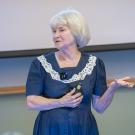
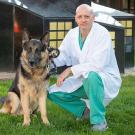
Dr. Niels Pedersen, a distinguished emeritus professor at the UC Davis School of Veterinary Medicine and a renowned expert on infectious and immunologic diseases in dogs and cats, says our pets are not at risk of contracting COVID-19.
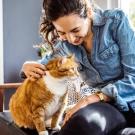
When Martin and Elisa Edwards of Berkeley, California visited an animal shelter ten years ago looking for a cat to adopt, one eager kitten took it upon himself to speed up the process and jumped on Elisa’s lap to introduce himself. The Edwards had found their new cat, along with his sister, and adopted them both. Tilden and Tess, now 10 years old, have enjoyed good lives with the Edwards. That is until about a year ago when Tilden started to get picky about his food.
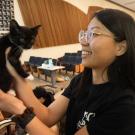
Though less common than their canine counterparts, therapy cats are making a tremendous difference in the lives of challenged children and lonely seniors.
Kevin, a 3-year-old male domestic longhair cat, required a CT scan to determine the extent of his maxillofacial injuries. Like with all cases in the Dentistry and Oral Surgery Service (DOSS) that need this imaging, Kevin was wheeled to the cone-beam CT machine by registered veterinary technicians (RVTs) Monica Calder and Megan Loscar. While this sounds like an easy enough task, it’s actually quite labor intensive due to the vastness of the UC Davis veterinary hospital.
Dinx, a 10-year-old female cat, was brought to the UC Davis veterinary hospital for evaluation of a low grade soft tissue sarcoma mass on her ear that grew back after surgical removal a year prior. Most likely, another surgery would be required to remove the mass.
Rhyme, a 2-year-old male ragdoll mix cat, was being medically managed for a liver shunt for the past six months. That followed nearly two years of trying to discover the root of his illness, which seemed to have plagued him for as long as could be remembered. When a specialist in Rhyme’s hometown of Vancouver, British Columbia finally diagnosed the shunt, he recommended Dr. Bill Culp at the UC Davis veterinary hospital, who has been performing a minimally invasive procedure to correct shunts in dogs for many years. Luckily for Rhyme, Dr. Culp has also utilized this technique in cats when presented with a similar scenario.
It’s fitting that Dr. Sara Thomasy is an ophthalmologist. Her eyes light up when she talks about the breakthroughs being made at UC Davis thanks to recent acquisitions of state-of-the-art imaging equipment. Eight new pieces of imaging equipment and one new piece of laboratory technology, made possible by grants from the Center for Companion Animal Health, now allow the Ophthalmology Service to provide new levels of care.
Thirty percent of cat owners surveyed use food puzzles, according to a new study led by researchers at the University of California, Davis. The puzzles benefit domestic cats by bringing out their natural foraging behavior.
There’s always an implicit comparison when we talk about cats as aloof little jerks, says Mikel Maria Delgado, a postdoctoral researcher on cat behavior at the University of California at Davis. And that comparison is with dogs, which humans have spent thousands more years domesticating and molding in our image. Cats, she pointed out, simply don’t have the facial muscles to make the variety of expressions a dog (or human) can. So when we look at a cat staring at us impassively, it looks like a psychopath who cannot feel or show emotion. But that’s just its face.