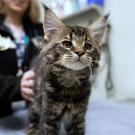
When tiny kitten Sunshine was brought to the Itsie Bitsie Rescue by a Good Samaritan, it was immediately clear to staff that she was not going to be a typical case. The rescue takes in approximately 750 kittens per year, mostly strays and transfers from shelters. These kittens are a highly vulnerable population and are the most likely to be euthanized at shelters. But maybe none as vulnerable as Sunshine.
“We could tell right away that she had pectus excavatum, but she was stable,” said Kristen Puff, director of operations at Itsie Bitsie Rescue.
Dr. Maria Vasquez already has a favorite aspect to her position in the small animal hospital—helping manage stress for clinicians and families with hospitalized pets. By getting more hands-on time with her patients, she provides an additional resource to medical teams and reassurance to clients that the best care is being provided for their beloved pets.
The top-ranked UC Davis Weill School of Veterinary Medicine may be known for its specialty care, but they also offer primary care for your animals. The Primary Care Service at the UC Davis Veterinary Medical Teaching Hospital, or VMTH, provides treatment to make sure that your canine or feline friend receives the routine care they need.
Researchers at the University of California, Davis, have uncovered new details about how a once-deadly coronavirus disease in cats spreads through the immune system. The findings may help scientists better understand long COVID and other long-lasting inflammatory illnesses in people.
UC Davis’ unique integration of human and animal health expertise has given a fluffy, friendly kitten a chance at survival — and opened the door to ideas that could someday help human patients.
When Erin Cooper noticed her Maine Coon kitten Viggo had an oversized head, she never imagined it meant something serious. But an MRI revealed feline hydrocephalus: a buildup of fluid inside the brain that is often fatal.
When Tommy Ma and Tiffany Pan adopted a 3-month-old Ragdoll kitten named Lychee in 2022, they expected joy, not heartbreak.
“Lychee was a dream come true,” Pan said. “Growing up, I’d never been allowed to have any large pets. Even cats are considered a large pet in my family.”
Just weeks after coming home, Lychee fell gravely ill. He began showing signs of feline infectious peritonitis, or FIP, a disease that was once fatal for cats.
At 5 weeks of age, kitten Ginger started regurgitating his food because a stricture was closing his esophagus to less than 1mm. The esophagus of a healthy kitten his age should be open 8 mm. He underwent a series of ballooning procedures at the UC Davis veterinary hospital to open his esophagus.
The UC Veterinary Medical Teaching Hospital opened the All Species Imaging Center, a central hub for all advanced diagnostic imaging including small animal computed tomography (CT), high field magnetic resonance imaging (MRI) for both small and large animals, positron emission tomography (PET)/CT for both small and large animals, and a dedicated large bore equine CT.
Scientists at the University of California, San Francisco and the University of California, Davis have completed the first clinical trial of a new cancer drug in pet cats, offering hope for a disease that has long been nearly impossible to treat. The study found 35 percent of the cats with squamous cell carcinoma who received treatment had their disease controlled with minimal side effects. The drug will likely be effective for humans with head and neck squamous cell carcinoma. The study was published today in Cancer Cell.
The UC Davis William R. Pritchard Veterinary Medical Teaching Hospital (VMTH) is pleased to announce that orthopedic surgeon Dr. Po-Yen Chou has achieved Fellow status in Joint Replacement Surgery (JRS) with the American College of Veterinary Surgeons (ACVS).