


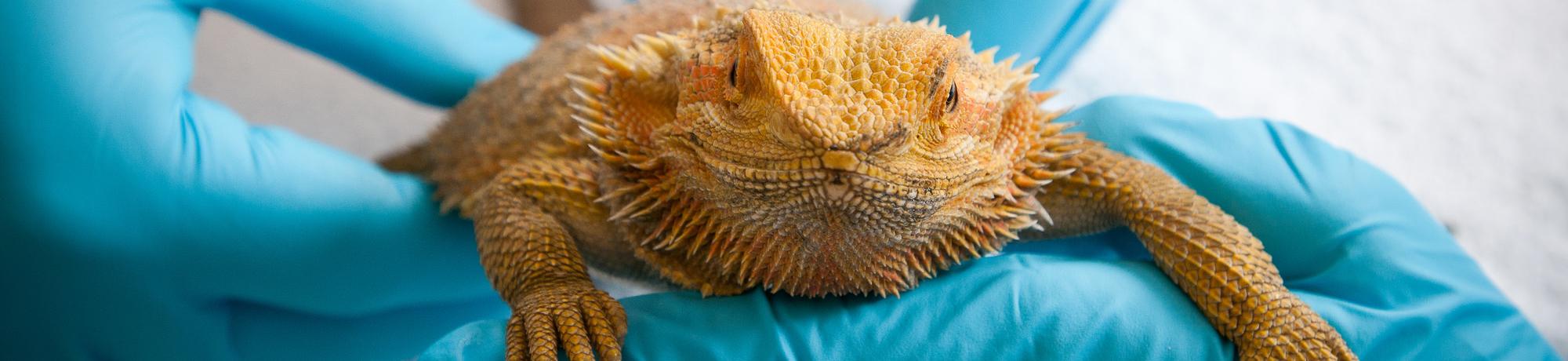
Welcome to the Companion Exotic Animal Medicine and Surgery Service at the UC Davis Veterinary Medical Teaching Hospital.

We provide comprehensive medical and surgical care for companion exotic animals, including wellness, emergency, and referral services.
Our clinicians have extensive experience in companion exotic animal medicine, and work with other specialists in the hospital to provide advanced care for our patients. Our team leaders are board-certified specialists in Zoological Medicine, Avian, and Fish Practice and oversee the cases working together with our veterinary residents and veterinary technicians. We are the largest team of exotic animal and zoological medicine specialists in California.
We also provide care to some injured wildlife. We work in conjunction with the California Raptor Center to rehabilitate injured birds of prey for release back to the wild. We also provide referral care for wildlife rehabilitators. Please note we are unable to accept injured bats, deer, raccoons, opossums or healthy baby birds that have fallen out of a nest. Unfortunately we do not have capacity to support those animals, and they should be brought to a licensed wildlife rehabilitator.
Appointments | Our Team | Exotics FAQs | Latest Clinical Trials
Animals seen by the service:
- Birds (parrots, chickens, raptors, passerines, toucans, etc.)
- Reptiles (snakes, lizards, turtles/tortoises)
- Rabbits and rodents (guinea pigs, chinchillas, rats, mice, hamsters, etc.)
- Ferrets, hedgehogs, and sugar gliders
- Amphibians (frogs/toads, salamanders)
- Fish (ornamental, food-fish, aquarium, research)
- Wild raptors and referred wildlife from licensed rehabilitation and nature centers
- Other species upon approval
Exotics services offered:
Emergency Care
Companion exotic animals often mask signs of disease, even from the most astute caregivers. Sudden changes in behavior, appetite, water intake, and fecal/urine output can be indications of serious illness. If your pet requires emergency care, please call our team at (530) 752-1393 so we can prepare for your pet’s arrival. Our service maintains a dedicated emergency line of receiving for these unexpected situations:
- Weekdays: 8:00AM to 5:00PM (Small Animal Reception B)
- Weekends & Holidays: 9:00AM to 5:00PM (Small Animal Reception A)
Primary Care
We encourage routine wellness examinations for all companion exotic animals. Exotic species have very specific dietary and housing requirements, and significant diseases can result when they aren’t met. Our goals are to enhance preventive health care by helping improve your understanding of animal housing, nutritional and behavioral needs, and preventative medicine such as vaccines and potential health hazards. Examples of primary care services include:
- Comprehensive husbandry review (housing, nutrition, behavior)
- Disease screening and prevention
- Health certificates for travel
- Pre- and post-purchase exams
- Sex identification
- Spaying and neutering
- Vaccinations
- Grooming services
Specialty Care
Our clinicians have specialized medical and surgical knowledge of exotic species and work in conjunction with other specialty services within the VMTH (i.e. cardiology, dentistry, dermatology, neurology, oncology, ophthalmology, behavior, surgery) when needed. This cooperative approach allows us to provide specialized medical and surgical options for your pet, no matter what their specific needs. Examples of specialized care include:
- Dental exams and procedures: occlusal adjustments (rabbits and rodents), dental extractions, ultrasonic cleaning (ferrets, bearded dragons)
- Specialized imaging: digital radiography, ultrasound, fluoroscopy (including gastrointestinal motility studies), computed tomography (CT or CAT scan), magnetic resonance imaging (MRI), positron emission tomography (PET) scan, and nuclear scintigraphy
- Soft tissue surgery, orthopedics, interventional radiology (e.g., aneurysm embolization in bearded dragons)
- Diagnostic endoscopic procedures (tracheoscopy, bronchoscopy, gastrointestinal endoscopy, laparoscopy) and minimally invasive surgery
- Chemotherapy and radiation therapy
- Infectious disease testing and management
- Physical therapy and rehabilitation
Mobile Care
Mobile care may be available for flock or herd examinations in breeding facilities or other large collections. We provide consultation for specialized aviculture or breeding needs such as housing, nutrition, and overall medical management.
- Please contact us via phone (530) 752-1393 or email ([email protected]) to discuss your mobile care needs
Fish Care
We provide medical services to private owners, hobbyists, breeders, wholesalers, research facilities, retailers, commercial aquaculture, aquariums, as well as government fish and wildlife conservation agencies. A wide range of services are available when clients bring their fish to the VMTH or the service can make off-site field calls. Field calls can be arranged within a 90-mile radius from the university. Specialized tests and services include:
- Water quality testing, wet mount examinations
- Microbiological analysis (virology, bacteriology, mycology)
- Fish hospitalization and on-site treatment
- Necropsy and histopathology (through VMTH-Pathology or CPL)
- Fish toxicology (through CAHFS)
- Telemedicine
Emergency Services
Monday - Friday: 8 a.m. - 5 p.m.
Weekends/Holidays: 9 a.m. - 5 p.m.
Please call before coming to the hospital.
(530) 752-1393
Client Appointments
Scheduled by calling the Small Animal Hospital.
Mon - Fri: 7:30 a.m. - 5 p.m.
(530) 752-1393
Referring Veterinarians
Contact: Cristin Dietrich
Phone: 530-752-6349
Email: [email protected]
Fax: 530-752-8906
Patient Referral Form (doc)
Ref Vet Information
Location
Center for Companion Animal Health - Small Animal Reception B
1115 Vet Med Circle
UC Davis Weill School of Veterinary Medicine
Veterinary Medical Teaching Hospital
1 Garrod Drive
Davis, California 95616


David Sanchez-Migallon Guzman — LV, MS, DECZM (Avian, Small Mammal), DACZM
Clinical Professor
Chief of Service

Hugues Beaufrere — DVM, PhD, DECZM (Avian), DABVP (Avian), DACZM (Zoological Companion Animals)
Associate Professor
Co-Director - California Raptor Center

Krista Keller, DVM, DACZM
Associate Clinical Professor


Adam Moreno, DVM
Resident III

Alex Berry, DVM
Resident II

Do Na Lee, DVM
Resident I

Michaela Mitchell, DVM
Resident I

Brian Anton, DVM, MS, CertAqV
Veterinarian - Aquatic Animal Health

Hery Ríos Guzmán, DVM
Fellow - Aquatic Animal Health

Celia Vilar, DVM
Intern

Nikki Rochin, RVT
Service Manager

Erin Johnston, RVT
Service Supervisor

Andrea Lynch, RVT

Max Contreras
Veterinary Assistant

Lauren Etter, RVT

Libby Lipowski, RVT

Valerie Varcados, RVT
Frequently Asked Questions
- Do I have to have a referral from a private practice veterinarian to be able to make an appointment with the Companion Exotic Animal Medicine and Surgery Service?
- No, the Companion Exotic Animal Medicine and Surgery Service provides primary care as well as care on a referral basis. You or your primary veterinarian can make an appointment by calling the Small Animal Hospital at (530) 752-1393. If your pet has previous medical records, please have them sent via email to [email protected] so our team can thoroughly prepare for your pet’s appointment.
- Can I make an appointment with one of the specialty groups (e.g., ophthalmology, cardiology, dentistry) for my companion exotic pet?
- Our service works closely with all the specialty groups at the VMTH. Our trained staff coordinates the appointment with the specialty group and provides the appropriate handling and care of your pet during the specialty examination. Please make the appointment for your pet with the Companion Exotic Animal Medicine and Surgery Service and we will ensure that the appointment is then coordinated with the specialty service. Please notify us when making the appointment of the specific needs of your pet.
- What can I expect at an appointment?
- You will be greeted by a student or veterinary technician who will take a history. Please provide as much detail as possible about your pet, including diet (specific brands/products) and husbandry information, so our team can obtain a complete understanding of your pet’s healthcare needs. The clinician will then perform a physical examination of your pet and provide you with basic diagnostic and treatment options, if needed. We can run basic blood tests, obtain radiographs and ultrasound studies, and perform minor surgical procedures on an outpatient basis.
Please arrive 10-15 minutes before your scheduled appointment. Our examination room is in a quiet area of the hospital to provide a secure and comfortable atmosphere for your pet. We understand that many of our exotic pet patients are uncomfortable around common domestic pets so our examination rooms are never used for dog or cat patients. Your pet’s physical exam may be performed in our treatment area, or you may request to be present for your pet’s exam in the examination room.
It takes time to discuss important husbandry and health issues, and you can expect at least one hour for your appointments. Your pet’s health needs will be discussed in detail. Written information from your appointment will be provided in the form of a physical printout and/or electronic communication via email or the Client Portal after your visit. - How long will an appointment take?
- The duration of your pet’s appointment will vary depending upon the diagnostic tests performed and the treatment that may be necessary. An uncomplicated appointment may take approximately one hour. Some other diagnostic tests (for example, radiographs) may take longer depending upon the type of diagnostic test required and upon the number of other patients in the hospital that require this test.
If all planned diagnostics or treatments cannot be completed during your appointment, a follow up appointment may be scheduled. - How often will I speak to someone at the hospital if my pet is hospitalized?
- The clinician or the student working closely with your pet will contact you daily to give you an update on your pet’s progress. You may also contact the hospital at (530) 752-1393 to speak with the care team working with your pet.
- If my pet is hospitalized, will my pet be housed with other species of animals?
- Our hospital wards are designed to accommodate the unique needs of our exotic patients. For example, we have separate wards for our avian and reptile patients that provide appropriate temperature and humidity requirements. Rabbits, guinea pigs, chinchillas, rats, and other small exotic mammals also have their own ward. Our exotic patients are kept in their unique wards unless more intensive monitoring necessitates hospitalization in our Small Animal Intensive Care Unit or Intensive Care Ward, which are shared with dogs and cats.
- Will I see the same veterinarian each time I bring my pet to the VMTH?
- You can request a specific veterinarian when you make your appointment and, when possible, we will accommodate your needs. Due to the dynamic nature of the service and our large team, we cannot always fulfill these requests. We make every effort to ensure consistent patient care, even if the same clinician does not see you and your pet.
- How can I get copies of my pet's records?
- The front desk staff can provide you with a copy of your pet’s medical records once it has been fully reviewed by the clinician (generally within 7-10 business days). Please specify if you would like also copies of imaging studies performed on your pet (e.g., radiographs, ultrasound, CT).
- How can I get a refill of a prescription?
- When you call the hospital, select the phone option to refill prescriptions. The pharmacy will contact your doctor if there is any question about refills. Medications can be picked up from our pharmacy or shipped to your home, for a fee. Information about the pharmacy’s location and hours is available on their website.
- Can the veterinarians from the Companion Exotic Animal Medicine and Surgery Service provide the primary care for the animals of my nonprofit organization?
- Yes, we can provide all aspects of veterinary care for the animals cared for by your nonprofit organization. We can provide services for your organization’s animals at the VMTH or we can visit your facility and provide (limited) onsite care. We can offer protocols for husbandry, nutrition and preventative care, as well as providing regular health checks of your animals. Individual animals requiring diagnostic work-ups or medical treatment will receive the same high level of care available to all patients presented to our service. Please contact us to discuss the potential veterinary needs of the animals under your nonprofit organization’s care.
- I found an injured wild animal, who can I call to provide medical assistance?
The Companion Exotic Animal Medicine and Surgery Service provides medical care for some sick and injured wildlife during daytime hours. Raptors (hawks, eagles, falcons, vultures, and owls) should be brought directly to the California Raptor Center for care. Skunks, deer, bats, raccoons, opossums, and venomous snakes will not be accepted. Healthy baby birds that have fallen out of a nest are also not accepted by the service. Please note that we are only able to provide veterinary evaluation of injured wildlife between the hours of 8 am to 5 pm.
For other wildlife, place the injured animal in a carrier or box to ensure your safety and the safety of the animal during transport to the hospital. When you bring a sick or injured wild animal to us, you will be asked to fill out a questionnaire about where the animal was found. This will help us to have the animal released when recovered back to the area where it was found.
The VMTH provides medical care for these animals; you are not responsible for the medical bills. We encourage donations to the wildlife fund at the VMTH to help support the care and treatment of wildlife by the Companion Exotic Animal Medicine and Surgery Service.
To protect yourself against rabies, do not touch sick or injured wild mammals such as skunks, bats, foxes, coyotes or raccoons, but instead contact your local animal control department or a licensed wildlife rehabilitator to transport the mammal for medical care. The animal control officers and the wildlife rehabilitators are specially trained to deal with potentially dangerous animals and have specialized equipment to prevent injury or exposure to rabies. We work closely with animal control and wildlife rehabilitators to provide medical care to sick and injured animals that they rescue.- How can I learn more about companion exotic pets?
- • American Veterinary Medical Association (AVMA): Selecting a pet for your family
• Association of Avian Veterinarians (AAV): Bird Owner Resources
• Association of Exotic Mammal Veterinarians (AEMV): Exotic Mammal Handouts & Resources and Tools
• Association of Reptile and Amphibian Veterinarians (ARAV): For Owners
• Merck Veterinary Manual (Pet Owner Version): Introduction to Fish