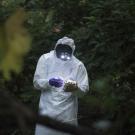
The sixth ebolavirus, Bombali virus, has been detected in insect-eating bats in Guinea. The discovery of Bombali virus first in insect-eating bats in Sierra Leone, and now in Guinea, marks the first time that scientists discovered a new ebolavirus species in a host before detection in an infected human or sick animal.
UC Davis scientists have pinpointed specific strains of the parasite Toxoplasma gondii that are killing southern sea otters, tracing them back to a bobcat and feral domestic cats from nearby watersheds.
An article in Salon describes how scientists over the last couple decades have compiled evidence that cat feces, which often drains into the ocean in coastal cities, can infect Hawaiian monk seals with toxoplasmosis — a potentially fatal disease caused by a single-cell parasite.
The Bodega Marine Laboratory’s white abalone program has millions of new additions following its most successful spawning ever at the University of California, Davis, facility.
Scientists report the first cases of foot disease for endangered huemul deer in Chilean Patagonia in a study led by the Wildlife Conservation Society and the University of California, Davis’ One Health Institute, with partnering institutions in Chile and the United States.
Two isolated mountain lion populations in Southern California’s Santa Ana and Santa Monica Mountains are at risk of local extinction, perhaps as soon as within 50 years, according to a study published in the journal Ecological Applications.
Many people set up hummingbird feeders in their yards to nurture and watch these high-energy pollinators. But could the sugar water they provide be impacting these tiny feathered friends?
In an increasingly crowded world where people and animals come into ever-closer contact, the lines that separate us – physical, biological, ecological, behavioral – are essentially gone. So, the future of conservation will be initiatives that address the entire ecosystem – a ‘One Health’ approach.