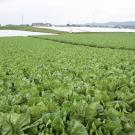
The Western Center for Food Safety—a joint effort between UC Davis’ School of Veterinary Medicine and the College of Agricultural and Environmental Sciences—will join several other California organizations to launch a multi-year study to improve food safety through enhanced understanding of the ecology of human pathogens in the environment that may cause food-borne illness outbreaks, according to a U.S. Food and Drug Administration announcement today.
UC Davis Graduate Studies recently honored 34 faculty members with Graduate Program Advising and Mentoring Awards, including Dr. Jeffrey Stott, a professor in the UC Davis School of Veterinary Medicine’s Department of Pathology, Microbiology, and Immunology, and member of the Graduate Group in Integrative Pathobiology.
Backyard poultry and small-scale livestock agriculture are a growing trend in the U.S., even in large cities such as Seattle, Portland, Denver and San Francisco. But how often do these owners seek veterinary care for their animals?
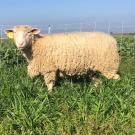
Livestock grazing could be beneficial for organic farming systems. To see if the practice poses any food safety risks, university, government and nonprofit partners - including the school's Alda Pires - will receive a nearly $1 million U.S. Department of Agriculture Specialty Crop Multistate Program grant to study the impacts of livestock grazing of cover crops on bacterial population dynamics, soil building and environmental health.
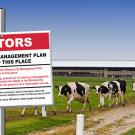
The Western Institute for Food Safety and Security (WIFSS) at UC Davis has been awarded a $560k grant from the USDA to develop a collaborative partnership between the university, federal agencies, state agencies, and animal agriculture industry to increase preparedness on dairy farms and poultry raising facilities.
Congrats to Cara Newberry, Class of 2022, for being among 10 students nationally to receive an inaugural veterinary fellowship from the Foundation for Food and Agricultural Research (FFAR) and AAVMC.
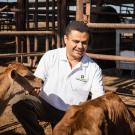
Bovine respiratory disease (BRD) is one of the most significant illnesses impacting the health of pre-weaned calves. It’s the #2 killer of pre-weaned calves and of particular interest to dairy farmers in California, the nation’s #1 milk producer. Producers now have a new diagnostic tool in hand—a phone app that leads them through a scoring system for BRD—that aims to improve the health of pre-weaned calves on California dairies.
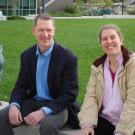
Keith Sollers has been announced as one of two new Innovator Fellows for Spring 2019 by the UC Davis Innovation Institute for Food and Health. He's working with Dr. Beatriz Martínez López to improve precision epidemiology for livestock through technology.
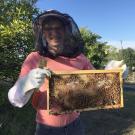
Bees are one of our planet's most important animals. They produce honey and they are the primary managed pollinators for a majority of high value specialty crops grown in the contiguous states of California and Oregon, such as nuts, stone fruits, vegetables, and berries. A problem looms for our animal friends, the bees. Colony losses are high due to a variety of environmental and biological causes including bacterial diseases.
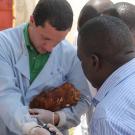
Dr. Rodrigo Gallardo may be a poultry medicine specialist who helps improve the wellbeing of chickens through research and education, but he also sees the far-reaching impact of his role. “By helping villages in other parts of the world maintain healthier poultry flocks, we’re assisting communities as a whole,” Gallardo explained. “If families can increase egg and meat production in their chickens because they are healthier, they have more financial resources to spend on health care and sending their children to school.”